If your team posts on social media more than almost anything else, you’re in good company. Punchy Studio’s State of Public Sector Communications 2026 survey of communications professionals across Australia found social media is used by 87% of respondents, more than any other channel. It’s also the channel they rated as one of the least effective, scoring 4.95 out of 7 on average, fifth out of seven channels measured.
That gap between effort and outcome is the paradox worth unpacking. This article draws on findings from Punchy Studio’s State of Public Sector Communications 2026. You can download the full research findings as a PDF to see how social media compares with video, email, community events and other channels across the full survey.
What the research actually found
The survey asked public sector communicators which channels they use and how effective they rate each one on a scale out of 7. The pattern that emerged wasn’t subtle:
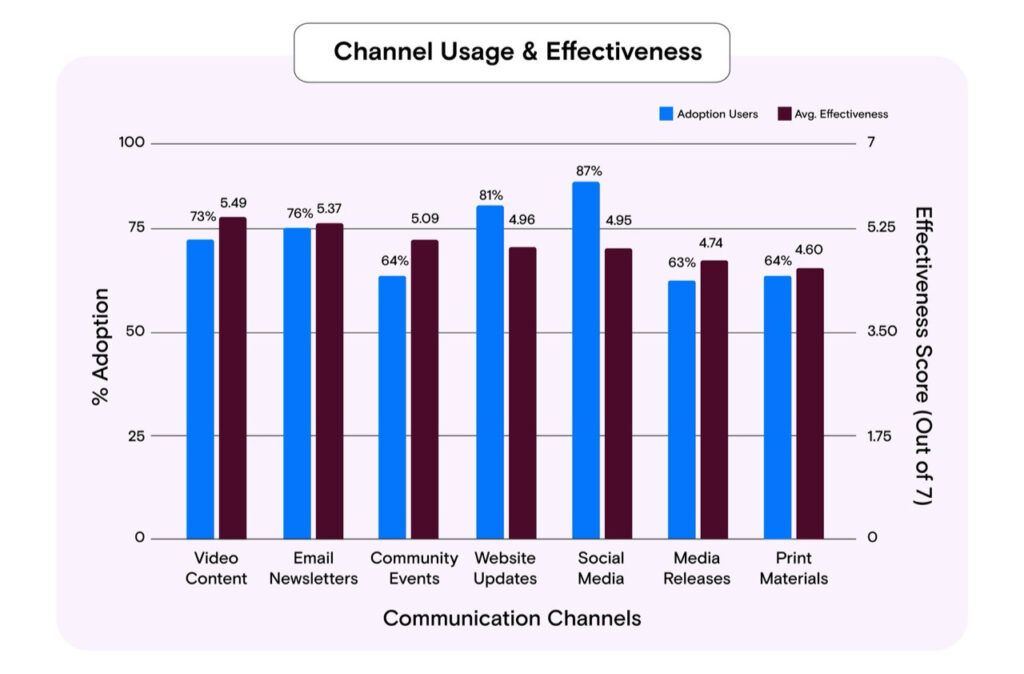
Social media leads every other channel on adoption but sits second last on effectiveness. Video, by contrast, is used by fewer teams (73%) yet rated the most effective channel overall. Email newsletters follow a similar pattern: less universally adopted than social or web, but rated well above both.
Respondents’ own assessments of channel strengths and weaknesses help explain why. Social media’s top strengths were measurable results and cost-effectiveness. Its top weaknesses were low audience engagement and the difficulty of measuring impact, an odd contradiction given “measurable results” was also listed as a strength, which suggests teams can pull numbers from social platforms easily enough, but struggle to connect those numbers to anything meaningful.
Why reach is so hard to earn now
Public sector teams aren’t imagining the difficulty. Organic reach, the proportion of your own followers who actually see an unpaid post, has been shrinking for years as platforms prioritise content from friends, family and paid advertisers over organisational and brand pages. As Hootsuite’s own analysis of organic reach puts it, reach is declining because social platforms prioritise paid content, and algorithm changes affect how posts are ranked and distributed.
This isn’t a niche problem limited to under-resourced departments. It’s structural. Every account competes for space in a feed that platforms have deliberately reshaped to favour paid and personal content. A well-produced post from a state health department is competing with a friend’s holiday photos, a creator’s video and multiple ads, all fighting for the same handful of seconds of attention.
At the same time, the audience itself hasn’t shrunk. DataReportal’s Digital 2026 Australia report puts the number of active social media user identities in the country at 21.0 million, equivalent to 77.7 percent of the total population, as of October 2025. That’s a huge potential audience. But growth in that user base has flattened, with the same report showing social media user identities in Australia increased by only 100 thousand, or 0.5 percent, between late 2024 and the end of 2025. The platforms aren’t adding new eyeballs at any pace. What they’re doing is deciding, algorithmically, whose content those existing eyes actually see. For an organisation without an advertising budget behind every post, that decision usually isn’t made in your favour.
None of this means social media has no place in a communications strategy. It means treating it as a guaranteed distribution channel, rather than a contested one you have to win attention on repeatedly, sets teams up to be disappointed by the numbers.
The trust problem compounds the reach problem
Reach is only half the story. Even when a government post does surface in someone’s feed, there’s a second hurdle: whether they trust what they’re seeing.
The University of Canberra’s Digital News Report: Australia 2026 found that Australians trust news they’ve sought out directly more than twice as much as they trust news encountered on social media, at 54 percent compared with 21 percent. That gap matters for anyone using social platforms to communicate policy changes, health advice or public safety information. The same post that struggles to be seen also carries less inherent credibility once it is seen, simply because of where it appeared.
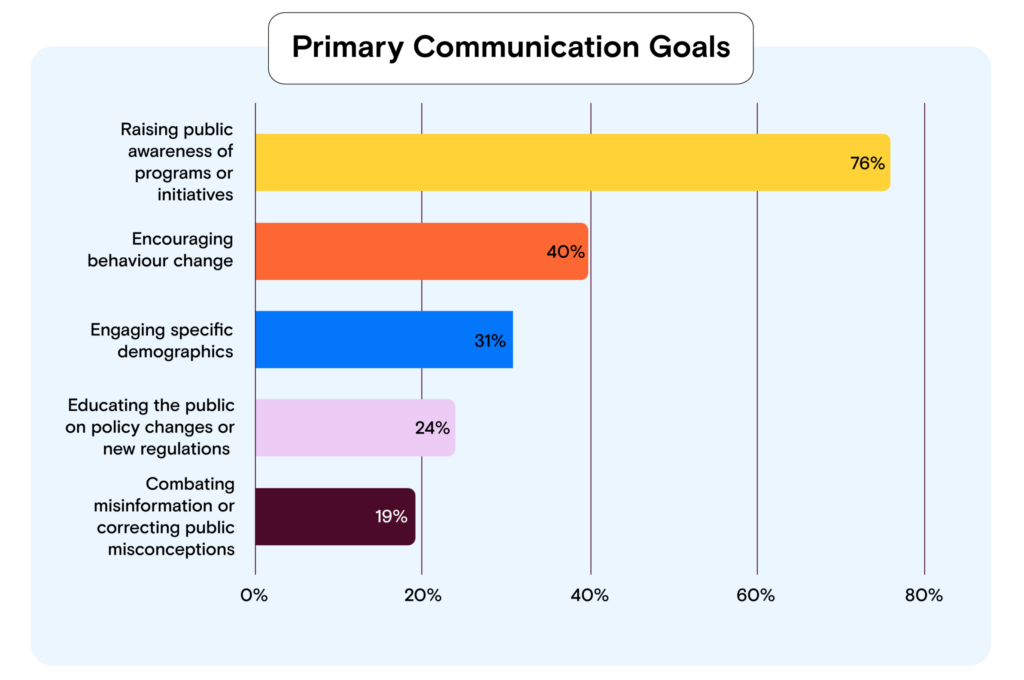
Misinformation compounds this further. The Australian Communications and Media Authority’s most recent research on how Australians encounter misinformation found that 64 percent of Facebook users had encountered misinformation on the platform over a six-month period, a figure that held steady from the previous year, with false or misleading information about social groups the most common type. Punchy’s own survey reflects the flow-on effect: combating misinformation now sits in the top five communication goals for public sector professionals, at 19%, a priority that would barely have registered a few years ago.
Put together, this is a genuinely difficult environment for social media as a primary channel. Reach is harder to earn, and even earned reach carries a trust deficit that owned channels like a website or an email newsletter don’t have to contend with in the same way.
Why owned channels are outperforming
This is where Punchy’s data offers a useful contrast. Email newsletters scored 5.37 for effectiveness, well above social media’s 4.95, despite lower adoption (76% versus 87%). Respondents rated high cost-effectiveness among the top strengths of email, alongside strong goal alignment.
The distinction is about ownership. An email subscriber list belongs to your organisation. Nobody can change an algorithm to decide whether your newsletter reaches its subscribers. The same applies, to a lesser extent, to a departmental website: it’s not competing for attention against unrelated content in a feed. Social media, by contrast, is rented space. You’re building an audience on infrastructure you don’t control, subject to rules that can and do change without notice.
Video tells a related but distinct story. It scored highest of all channels for effectiveness (5.49) despite being used by fewer teams (73%) than social media, website updates or email. Punchy’s research found the main barriers to greater video use were budget constraints (70%), lack of production time (55%) and limited internal expertise (43%). In other words, teams recognise video works. What’s stopping them is capacity, not conviction.
What this means for a government communications strategy
None of this is an argument for abandoning social media. It’s the most widely used channel for good reason: it’s fast, low-cost to post on, and reaches audiences that don’t check a departmental website or a print newsletter. The issue is proportion. When social media consumes a disproportionate share of a team’s time relative to what it delivers, that’s worth re-examining.
A few practical shifts follow from the data:
- Treat social media as top-of-funnel, not the primary driver. Use it to build awareness and direct people toward higher-trust, higher-effectiveness channels like email or a dedicated web page, rather than expecting it to carry the full weight of behaviour change on its own.
- Invest in owned audiences. Growing an email subscriber list is less exciting than a social campaign, but the effectiveness data suggests it delivers more reliably. It also insulates communications from algorithm changes entirely outside your control.
- Shift some production budget toward video, even modestly. Given video’s effectiveness score and the fact that budget and time are the two biggest barriers cited by respondents, a “two tier” approach, using agencies for higher-stakes campaigns and simple in-house tools for quick updates, can lift output without needing a full production budget increase.
- Measure outcomes, not just output. Social media’s own respondents flagged “difficulty measuring impact” as a top weakness. Vanity metrics like likes and shares are easy to report but don’t tell you whether behaviour actually changed. Where possible, tie social activity to a measurable action, such as a call-centre enquiry drop or a form completion, rather than reach alone.
- Be deliberate about which messages go where. Sensitive, complex or high-stakes information (policy changes, health guidance, emergency updates) benefits from the higher trust levels of owned channels and direct communication, with social media used to point people toward it rather than deliver it in isolation.
The takeaway
Social media isn’t failing because public sector teams are doing it badly. It’s failing to deliver proportionate to its use because the platforms themselves have changed how visible any single, unpaid post can be, and because audiences increasingly trust it less than news and information they’ve sought out directly. Punchy’s research and the wider evidence on organic reach and public trust point the same direction: channels an organisation actually owns, like email, a website or well-made video, are outperforming the channel that consumes the most time and attention.
For teams looking to shift more of their communications budget toward higher-effectiveness formats without adding significant production overhead, exploring professional video and explainer content is a reasonable place to start, particularly for the policy explanations and behaviour change messages that Punchy’s research shows respond best to video.