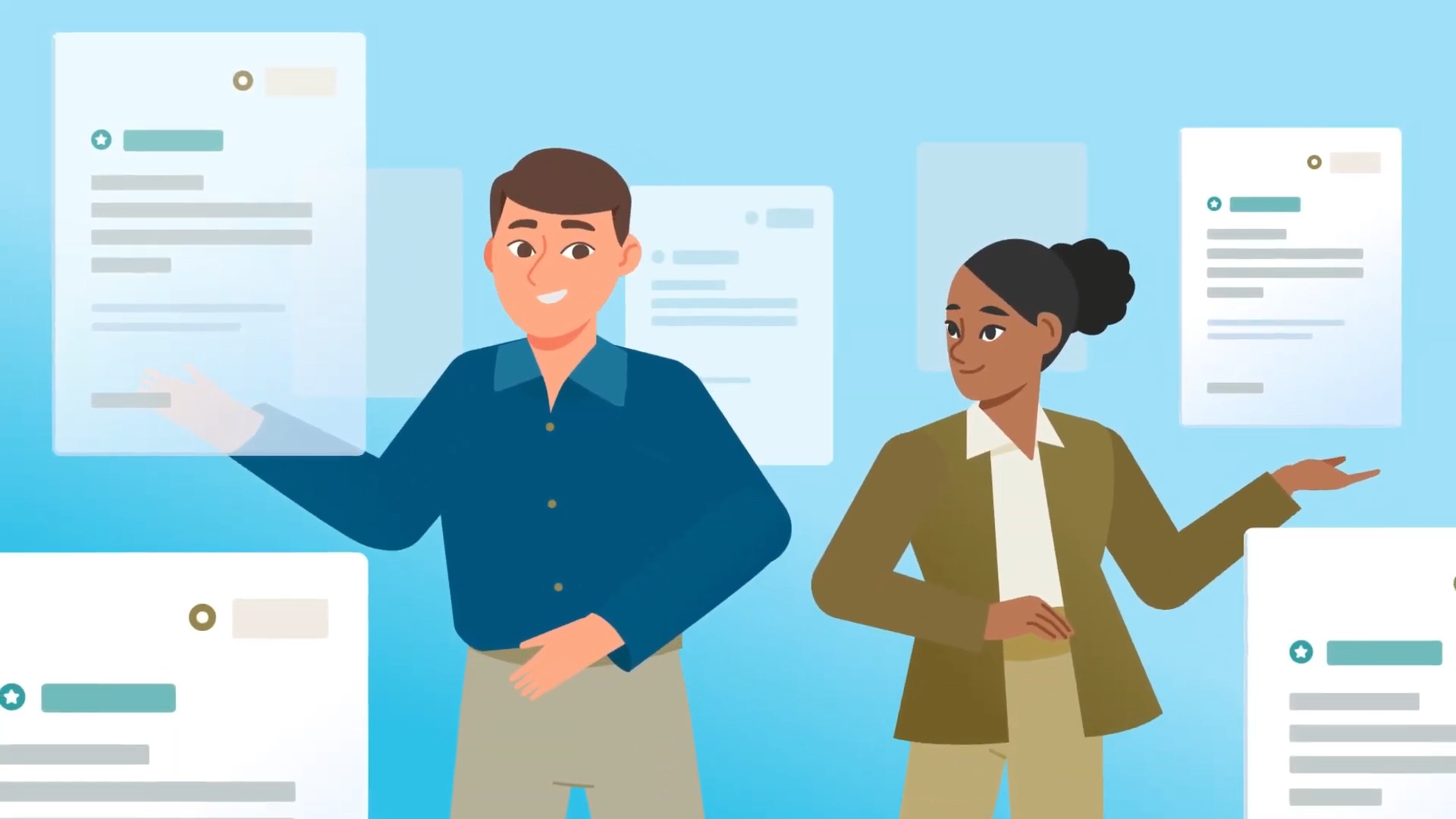
Nobody reads a tariff schedule for fun, and almost nobody sits through a claims process document unless they are already in the middle of a claim. 96% of people have watched an explainer video to learn about a product or service rather than work it out from a document, and enterprise buyers behave the same way when the thing they’re evaluating is technical, regulated, or simply invisible: a compensation scheme, a compounding process, a piece of dealer software.
An animated explainer video for a business is the format built for exactly that gap. Illustration, character design, and motion graphics do the job a document or sales deck can’t, compressing a complex offering into something a prospect or stakeholder can follow in under two minutes.
It’s also no longer a niche tactic. 68% of video marketers now produce explainer videos, second only to social content as a use case, and every entry in this post was built to sit at that point where a business audience is already looking for a shortcut past the fine print.
The examples below aren’t simply creative showcases. They’re real projects developed to solve communication challenges across product education, workforce training, risk communication and category positioning. If you’re wondering whether animation is the right way to explain something that’s too technical, too abstract or too difficult to demonstrate with live action, these examples show what’s possible.
Types of Business Explainer Animation
Not every business explainer is solving the same problem. The 14 examples below fall into four working categories, and the category shapes the script, the tone, and where the finished video gets used.
1. Product and platform explainers
Videos built to explain what a piece of software, a fund, or a membership product actually does, aimed at a buyer who has limited patience for a feature list. These lean on relatable scenarios rather than screen recordings, and usually sit on a website or in a sales deck. Most of this work runs through our explainer video service.
2. Risk, safety and compliance training
Animations built for frontline staff, contractors, or claims teams, designed to embed a protocol or set of behaviours that has real safety or legal consequences if it is ignored. These need to survive stakeholder and legal review, which puts a ceiling on how loose the script can be. Our training video service covers most of this category.
3. Regulatory and scheme explainers
Videos that explain how a government-linked scheme, a utility tariff, or a regulated compensation model actually works, aimed at a public or customer audience that has no reason to already understand the mechanics. Accuracy matters more than personality here, and the client’s own attribution and terminology need to be followed precisely.
4. Brand and category education
Videos that argue a point of difference for a category the audience may not think much about, whether that is compounded medicine, tunnel engineering, or weather-related insurance risk. These sit at the top of the funnel and are built to be reused for years.
14 Best Business Explainer Video Examples
1. Bova
Bova is an Australian veterinary compounding pharmacy, and its Quality Assured lines are genuinely a step above most competitors. That is hard to see on paper. A cheaper product from a shopfront compounder can look identical on the surface. Bova needed vets to understand the specific difference, so they could make a confident choice and advocate for it with colleagues and pet owners.
The one-minute animation we produced walks through Bova’s quality process in a single, confident sequence. Animation gave full control over what the audience sees and when, making invisible quality control processes visible without the result feeling like a facility tour. The video opens on the patient, furry, feathered, or finned, then builds the argument step by step, without ever naming a competitor. It closes on an apples-and-pears metaphor that lets the audience draw the conclusion themselves.
We produced this for Bova so vets could leave the video with the knowledge to justify a Quality Assured product at a higher price point, and the language to recommend it with confidence.
2. EasyCars
EasyCars is dealer management software built for Australian used car dealers, covering accounting, inventory and compliance in one platform. The brief was to explain what the platform does and why dealers should switch, without leaning on a dry feature list that would lose a time-poor dealership owner in the first ten seconds.
The character animation we produced follows a typical day inside a dealership, showing where admin friction shows up and how the platform removes it. The tone is pitched at small business owners rather than IT buyers, since that is who actually makes the switching decision.
We produced this for EasyCars for the website, sales decks and paid social, with scripting, character animation, motion graphics and voiceover.
3. Hayylo
Hayylo is a communication platform built for Australian care service teams navigating workforce shortages and regulatory reform. Manual processes and disconnected legacy tools were leading to missed enquiries and overwhelmed staff, and the brief was to show how the platform fixes that without adding another disruptive system on top.
The animated explainer we produced opens on the chaos of uncoordinated care delivery before introducing the platform, using a clean visual style to show how enquiries get centralised and how the software plugs into existing systems rather than replacing them. Motion graphics are used to make integration points, the part most software explainers gloss over, genuinely legible.
We produced this for Hayylo for the website and LinkedIn, targeting aged care and disability support providers evaluating a switch.
4. Defit Group
Defit Group provides industrial defit and strip-out services for commercial fitouts, a niche service that is hard to explain in dense technical copy. The brief was to make the offering clear and credible to prospective clients who may never have needed this kind of contractor before.
The animated explainer we produced walks through what Defit does, who it is for, and what makes their approach different, using a clean illustrative style and a steady voiceover rather than jargon.
We produced this for Defit Group for the website and business development conversations, giving the team a consistent introduction tool for new prospects. Services included scripting, character and asset design, animation, motion graphics and voiceover.
5. Motor Accidents Compensation Commission (MACC)
The Motor Accidents (Compensation) Commission is the Northern Territory body responsible for the no-fault motor accident compensation scheme, administered operationally through Allianz Australia from its Darwin office. MACC needed Territorians to understand who is covered, what benefits are available, and how a no-fault scheme works in practice.
The animated explainer we produced covers eligibility, benefits (medical treatment, income replacement, lump sum compensation for serious injury) and the claims process, explaining that support is available regardless of who caused the crash.
We produced this for MACC’s road safety and scheme awareness work, embedded on the MACC website and used in NT community engagement.
6. EML
EML manages personal injury claims and works with employers to improve recovery outcomes for injured staff. The brief focused on the critical window immediately after an injury, where early notification and consistent communication from an employer can change the trajectory of someone’s recovery and reduce the business’s own exposure to lost productivity.
The animated training video we produced sets out concrete strategies for employers, such as early intervention packs and involving direct supervisors in the recovery process, and uses motion graphics to make legislative timeframes and return to work plans easier to follow than the underlying documents.
We produced this for EML as part of a series of videos, aimed at reducing poor recovery outcomes and the compensation costs that follow them.
7. Service Stream
Service Stream is an Australian utility services contractor whose meter readers enter thousands of properties a week, many with dogs on site. After a fatal dog attack on a meter reader at another company in Queensland, Service Stream developed the DOGSAFE protocol to give field crews a clear, step-by-step way to assess and manage dog-related risk, including for a culturally and linguistically diverse workforce.
The eight-minute animated training video we produced balances a serious safety message with character-driven humour, taking visual cues from the bright, lively aesthetic the client referenced. It walks through realistic on-the-job scenarios and illustrates each step of the DOGSAFE acronym in action, built from client-supplied incident scenarios.
The video underpins Service Stream’s DOGSAFE training rollout, with staff completing a learning assessment afterwards and success measured against reductions in dog-related field incidents.
8. Ghella SpA
Ghella is an international construction company specialising in major infrastructure, with a history spanning more than 150 years and five generations. The brief was to communicate the scale of that history and expertise, including more than 180 tunnels and 18 metro lines worldwide, to partners and clients who see the finished infrastructure but rarely the company behind it.
The 2D animated video we produced uses a map-based narrative to track Ghella’s expansion from Italy to Australia and New Zealand, referencing local projects such as the Legacy Way Tunnel in Brisbane and the Sydney Metro alongside technical motion graphics for project specifications.
We produced this for Ghella to strengthen relationships with partners and clients, positioning 150 years of tunnelling and civil engineering expertise against current work in hydropower and renewable energy.
9. Gow-Gates Group
Gow-Gates is an Australian insurance brokerage specialising in risk management. The brief was to educate directors and officials of sporting associations on their responsibilities for overseeing physical, financial and legal risk, condensed into two clear stages: risk assessment and risk control.
The animated explainer we produced sets out practical steps for sports clubs, including match day checklists, securing equipment, and dual signature policies for financial transactions, framing risk management as ongoing prevention rather than a compliance box to tick.
The video is deployed on the Gow-Gates website and shared with sporting bodies, directing officials to Gow-Gates or their own association for further support.
10. Alinta Energy
Alinta Energy is one of Australia’s largest gas and electricity retailers. We have produced a long-running series of explainer and marketing videos for Alinta covering smart meters, carbon offsetting, rebranding, and product initiatives, of which “Tariffs Explained” is one entry.
This animation breaks down how energy tariffs work, the different tariff types on offer, and what customers should check when comparing plans, following Alinta’s existing brand system so it sits naturally alongside their other content.
We produced this for Alinta’s customer education output, deployed across the website, customer communications and social channels.
11. ANZIIF
The Australian and New Zealand Institute of Insurance and Finance (ANZIIF) is the peak membership and education body for the insurance and financial services industry. The brief was to introduce a more flexible education model, specifically shorter “skills units” that let learners work toward recognised qualifications at their own pace, to professionals who assume upskilling means a long course they don’t have time for.
The animated explainer we produced contrasts these shorter study blocks with traditional education formats, and shows how units combine by job role into industry-recognised certificates and diplomas.
We produced this for ANZIIF for the website and member communications, aimed at insurance professionals evaluating whether to take the next step in their qualifications.
12. Vision Super
Vision Super is a profit-to-member superannuation fund based in Melbourne, serving over 100,000 members. Superannuation is widely perceived as confusing, and the brief was to explain super as a retirement asset and clarify the difference between accumulation plans and defined benefit funds without losing the audience halfway through.
The animated explainer we produced uses relatable characters and clear iconography to show how employer and personal contributions grow over time, and how investment earnings, taxes and fees each affect the final balance.
This explainer for Vision Super was for the website and member onboarding, as a foundational financial literacy resource for their community.
13. Transgrid
Transgrid operates the high voltage electricity transmission network across New South Wales and the ACT. The brief was to explain the shift from coal power to renewable energy sources, specifically solar, wind, hydro and geothermal, and to clarify Transgrid’s own role in the infrastructure upgrades that make that transition possible.
The animated explainer we produced uses clean, environmental visuals to contrast renewable resources with finite fossil fuels, and focuses on tangible outcomes for Australians: reliable energy supply and regional jobs.
We produced this for Transgrid’s website and social channels, aimed at the public and stakeholders following the network’s current projects.
14. Steadfast
Steadfast is the largest general insurance broker network and underwriting agency group in Australasia. The brief was to help businesses understand the risks associated with La Niña weather patterns, specifically high winds and increased rainfall, and how those conditions affect industries from agriculture to construction to hospitality.
The animated explainer we produced uses professional character design to outline relevant insurance protections, from machinery breakdown to legal liability, built around a message of proactive planning rather than reacting after a loss.
We produced this for Steadfast’s broker network and digital platforms, aimed at driving enquiries from clients reviewing their cover ahead of a La Niña season.
Animation vs Live Action for Business Communications
Enterprise and corporate clients often assume a corporate video means live action by default. That is not always the right call, and the wrong choice wastes budget on a video that gets one viewing and then sits unwatched. Here is how we think about it.
Animation is usually the right call when:
- The subject is a process, a system, or a piece of software rather than a person or a place (a claims process, a tariff structure, a compensation scheme).
- The content needs to survive years of reuse without dating, which rules out office fit-outs, hairstyles, and specific hardware.
- You are explaining something regulated or invisible, such as a scheme’s legal mechanics or a supply chain’s quality controls, where filming the real thing is impractical or impossible.
- The message needs a lighter tone to land a serious point, as with safety training that has to hold attention without becoming grim.
Live action is usually the right call when:
- Trust depends on seeing a real person, such as a corporate video featuring leadership or a genuine customer testimonial.
- The setting itself is doing the selling, such as a facility, a construction site, or a piece of physical infrastructure.
- You need a case study video for a board, an investor, or a funder where authenticity carries more weight than polish.
- The audience is evaluating a vendor relationship and wants to see the people they would be working with.
In enterprise communications, the two formats often work together. Animation handles the conceptual and educational layer that would be expensive or impossible to film. Live action handles the human and credibility layer. Getting that split right usually starts with a clear content strategy before either goes into production.
FAQs
What is an animated explainer video for a business?
An animated explainer video for a business is a short, scripted video that uses illustration, character animation, and motion graphics to explain a product, service, scheme, or internal process. They typically run between 60 seconds and 3 minutes and are used by enterprise businesses, regulated industries, and government-linked schemes to reduce a complex offering to something a prospect or customer can absorb quickly. Unlike live action, animation allows full control over what the viewer sees, which matters when the subject is invisible (a claims process, a tariff structure), abstract (a superannuation product), or too regulated to film candidly. The 14 examples in this post span product explainers, safety training, scheme communication, and category positioning.
How long should a business explainer video be?
For a customer-facing explainer, 60 to 90 seconds is usually the right length. 71% of marketers consider videos between 30 seconds and 2 minutes to be the most effective length, and enterprise buyers are no more patient than consumers when a video runs long. For internal training and compliance content, such as the Service Stream and EML videos in this post, 3 to 5 minutes is acceptable because the audience is watching with intent as part of a required process. If a script does not fit the shorter format, the fix is almost always to narrow the scope or split it into a series, not to let the video run long.
Why use animation instead of live action for enterprise communications?
Animation gives full control over representation and pacing, which matters when a business is explaining a regulated scheme, a technical process, or software that has no interesting visuals to film. It also ages better, as a well-made explainer can sit on a website for years without looking dated, unlike live action shot in a specific office or year. 50% of B2B buyers rely on video content to help them make purchasing decisions, and for products or services that are genuinely hard to picture, an animated explainer often does that work more clearly than a filmed demo or a testimonial. Live action remains the better choice when the point is proving a real person or a real result exists, which is why many enterprise programs use both.
What business topics work best for animation?
Animation works well for anything abstract, regulated, or difficult to film. For example, software platforms (EasyCars, Hayylo, Vision Super), compliance and safety training (Service Stream, EML, Gow-Gates), and government-linked schemes where accuracy and specific terminology matter more than visual flair (MACC, Transgrid, Alinta). It also suits category education for businesses whose point of difference is invisible on the surface, such as pharmaceutical quality control (Bova) or engineering scale built up over 150 years (Ghella). It works less well where the entire point is proving a real customer, leader, or facility exists, which is better served by live action.
How do you measure the success of a business explainer video?
Success should be defined in the brief, not decided after the video is delivered. For product and platform explainers, the metrics that matter are usually comprehension, time to first enquiry, and conversion from view to lead. For training and compliance content, such as the Service Stream and EML videos in this post, success is measured by assessment completion and downstream outcomes, in Service Stream’s case a reduction in dog-related field incidents. Customer outcomes and results are rated the single most persuasive proof type by B2B marketing leaders, which is why specific figures matter more in an explainer than general claims. A distribution strategy agreed before production starts makes all of this measurable from day one.
Conclusion
Across these 14 examples, the pattern is consistent. The strongest business explainer videos are not the ones with the most polished animation or the longest run time. They are the ones where the brief nailed down exactly what the audience did not understand before scripting began, whether that was a tariff structure, a safety protocol, or the difference between two compounded medicines.
Animation gives enterprise businesses control over that clarity in a way live action rarely can, which is why it keeps showing up as the default format for product explainers, compliance training, and scheme communication across regulated Australian industries.
If you are scoping an animated explainer for a product, a compliance requirement, or a scheme your business needs the public to understand, we would be glad to talk through the brief and the format that will get it there.
Get in touch to book a call.
Sources
- Wyzowl (2026), Video Marketing Statistics 2026. https://wyzowl.com/video-marketing-statistics/
- Vidico (2026), 70+ Video Marketing Statistics for 2026. https://vidico.com/news/video-marketing-statistics/