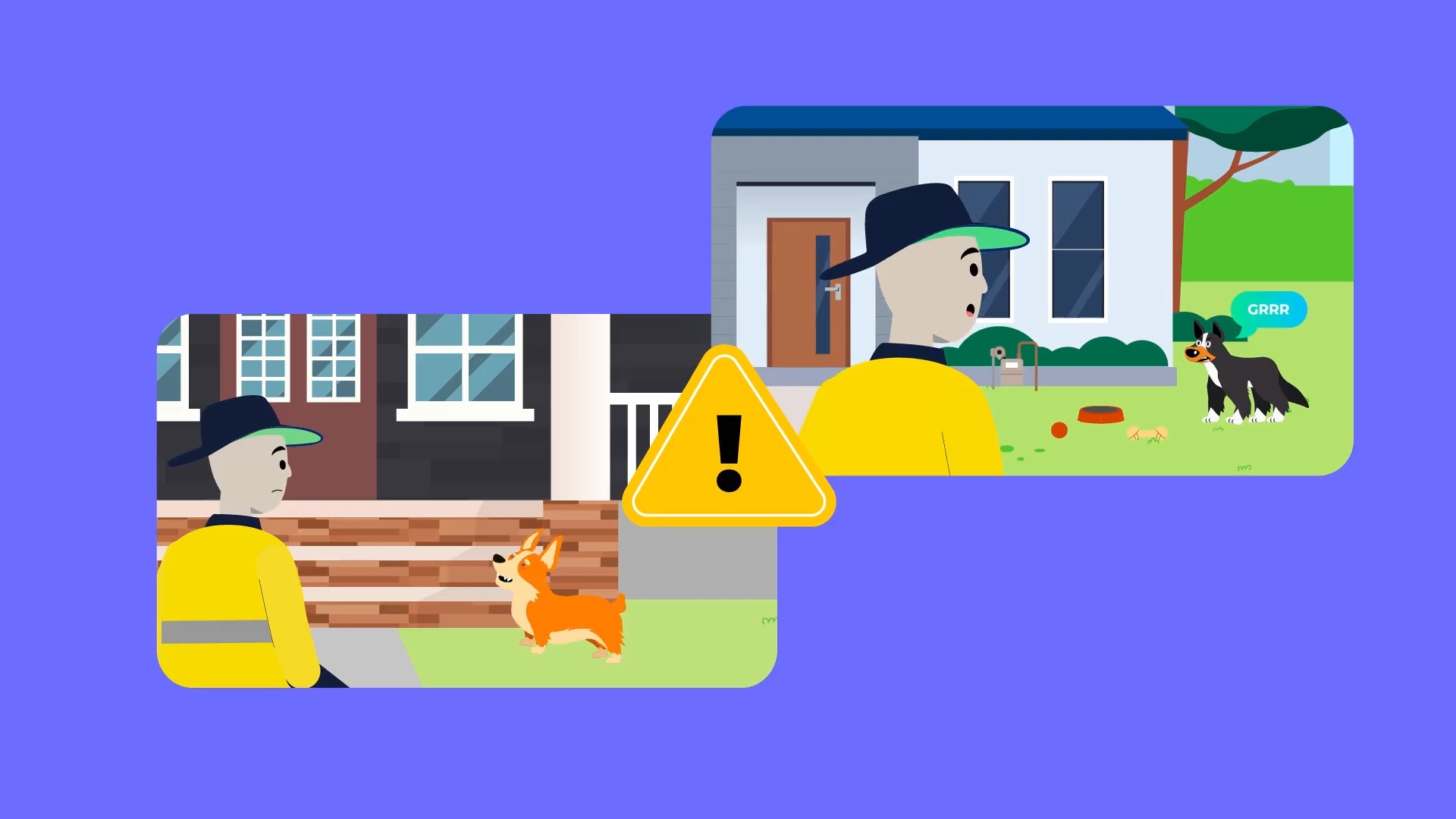
The Slide Deck Has Done Enough
Walk into almost any workplace safety induction or compliance training session in Australia and you will encounter the same format: a presenter working through a slide deck, covering regulatory requirements, safety procedures, and compliance obligations while a room full of learners either take notes or quietly disengage. It is a format that has persisted for decades, not because it works particularly well, but because it is familiar and because producing something better has historically required significant time and resource.
That constraint has changed. For safety and compliance training teams across government, enterprise, and high-risk industry sectors, animated training video content is increasingly the format that outperforms slide-based delivery on every meaningful measure: learner engagement, knowledge retention, training consistency, and the ability to reach dispersed or shift-based workforces who cannot all attend the same session.
The evidence for this is not new. Learning science has consistently demonstrated that information delivered through multiple simultaneous channels, visual, auditory, and contextual, is retained more effectively than information delivered through a single channel. A well-produced animated training video delivers all three at once. A slide deck and a presenter deliver, at best, one well and two inconsistently.
Why Safety and Compliance Content Specifically Benefits From Animation
Not all training content benefits equally from animation. For conceptual or procedural content, where the learner needs to understand a process, a system, or a set of rules and their consequences, animation has a particularly strong advantage. And safety and compliance training is almost entirely made up of exactly this kind of content.
Consider the challenge of explaining a high-voltage isolation procedure to a mixed-experience group of electrical workers and apprentices. The procedure involves multiple steps, specific equipment states, safety checks, and regulatory requirements. In a slide deck, this is a series of bullet points, perhaps accompanied by a static diagram. The learner must translate that abstraction into a mental model of what the procedure looks like in practice.
In an animated training video, the procedure unfolds visually, step by step, with each action shown in context. The learner sees the equipment, the correct sequence, the safety checks, and the consequences of deviation. The mental model is built through observation rather than abstraction, and it is built consistently for every learner who watches the video, regardless of their experience level or the quality of the person who would otherwise be presenting the content.
For apprentices and early-career workers, this is especially significant. Technical language creates real comprehension barriers for people who are still building their professional vocabulary. Animation removes that barrier by showing rather than telling, making the content accessible to a wider range of learners without reducing the rigour of the safety information itself.
Consistency Across Sites, Shifts, and Experience Levels
One of the most significant operational problems with slide-based and presenter-led compliance training is inconsistency. The quality of delivery varies by presenter, by site, by time of day, and by how engaged the room happens to be on a given afternoon. Two workers at the same organisation can complete the same required training and come away with substantially different levels of understanding, depending entirely on who was in the room and how well the session was run.
Animated training video eliminates that variability. Every worker at every site, on every shift, watches the same content, delivered with the same clarity, the same emphasis, and the same visual demonstration of correct procedure. For organisations managing safety training across multiple locations, this consistency is not just a quality improvement. It is a risk management strategy.
It is also a compliance advantage. When a regulator or auditor asks whether all workers have received equivalent training on a specific safety procedure, the answer is straightforwardly yes when the training is delivered through a standardised video. When the answer relies on the consistency of multiple presenters across multiple sessions, it is considerably harder to verify.
On-Demand Access for Dispersed and Shift-Based Workforces
Safety and compliance training that requires a room, a presenter, and a scheduled session creates logistical challenges for organisations with dispersed sites, rotating shifts, or workforces that include contractors and casuals who are not always on-site for scheduled training events. The result, in many organisations, is that training falls behind, records are incomplete, and compliance gaps accumulate quietly until an incident or an audit makes them visible.
Animated training video content that is accessible on-demand, whether through a learning management system, an intranet, or a shared drive, solves this problem directly. Workers can complete required training when they are on-site, on the relevant shift, and in the right context to apply what they are learning. New starters can complete induction training before they step onto the floor. Refresher training can be completed in fifteen minutes rather than requiring a half-day session to be scheduled and staffed.
For enterprise organisations with large or geographically distributed workforces, this shift from scheduled delivery to on-demand video access also generates meaningful cost savings. Reduced presenter time, fewer travel requirements for centralised training events, and faster onboarding for new starters all contribute to a return on investment that makes the production cost of high-quality animated training content look very reasonable.
Keeping Compliance Content Current
Safety regulations, technical standards, and compliance requirements change regularly. For training teams managing a library of compliance content, this creates an ongoing maintenance challenge. Slide decks can be updated relatively quickly, but the update only improves the content when a presenter actually delivers it, and there is no guarantee that the updated version is the one being used across all sites.
Animated video content requires more initial investment than a slide deck, but it also supports more systematic version control. When a regulatory update requires a change to a training video, the update is made once and distributed centrally. Every worker who watches the training from that point forward receives the current version. There is no risk of a site continuing to use an outdated slide deck because nobody communicated the update to the local trainer.
For training teams managing content across complex regulatory environments, including WHS legislation, environmental compliance, and technical standards that vary by site or jurisdiction, this kind of systematic currency management is a significant operational benefit.
Building a Training Video Library That Grows With Your Organisation
The most effective approach to animated training video for safety and compliance teams is not a single video, but a planned library of content that covers the full range of training requirements in a consistent visual style. When animated training content is designed as a cohesive system from the outset, shared visual assets, consistent character design, and a unified animation style create a library that feels professionally coherent and reinforces organisational safety culture across every piece.
Planning the library structure upfront also allows production to be staged across budget cycles, with the highest-risk or highest-volume training modules prioritised first and additional content added progressively. A production partner who understands the long-term vision can build the initial content in a way that makes future additions efficient rather than requiring each new video to start from scratch.
If your safety or compliance training team is ready to move beyond slide decks and build training video content that genuinely improves learner outcomes and simplifies your compliance obligations, get in touch with the Punchy Studio team. You can also view our portfolio to see how organisations across safety-critical and regulated sectors have used animated video to make training content that actually works.