Almost half of Australian adults have low or very low literacy.
It’s a stat that’s easy to scroll past, but it has real consequences for every piece of communication produced in the government, health, education, and not-for-profit sectors.
In a recent session with Jess Mathew, co-founder of Plain Language Matters, we unpacked what plain language actually is, why so many organisations get it wrong, and what you can do differently starting today.
Who is the excluded 44%?
44% of Australian adults sit at level 2 literacy or below, meaning they read at roughly a year 7 to year 10 level. That breaks down as:
- 3.7% below level 1 (pre-primary)
- 10% at level 1 (pre-year 1 to year 6)
- 30% at level 2 (year 7 to year 10)
Between 40% and 70% of First Nations adults have low or minimal English literacy, with the gap particularly apparent in remote communities. Low literacy is directly linked to barriers in employment, costing Australia an estimated $16 billion annually.
What people typically think of as a niche accessibility concern is really a mainstream communication failure affecting nearly half the population.
Add to that the sheer volume of information people process daily (researchers estimate around 100,000 words) and the picture becomes more urgent. Your audience is time-poor, cognitively loaded, and scrolling fast. If your content doesn’t earn their attention in the first three seconds, it’s gone.
What plain language actually is
In 2023, the International Organisation for Standardisation formalised a global definition of plain language. It now sits as an international standard alongside food safety, information security, and OHS frameworks.
Plain language is communication that puts the audience first. It ensures your reader can find what they need, understand it, and use it. It accounts for what they want and need to know, their level of interest, expertise and literacy, and the context in which they’ll use the content.
What makes this hard is that most of us were trained to write in the opposite direction. Complexity is rewarded in academia and in professional life. Dense, formal writing signals expertise. Plain language requires an unlearning of that.
The shift is from “what do I need to say?” to “what does my audience need to understand?”
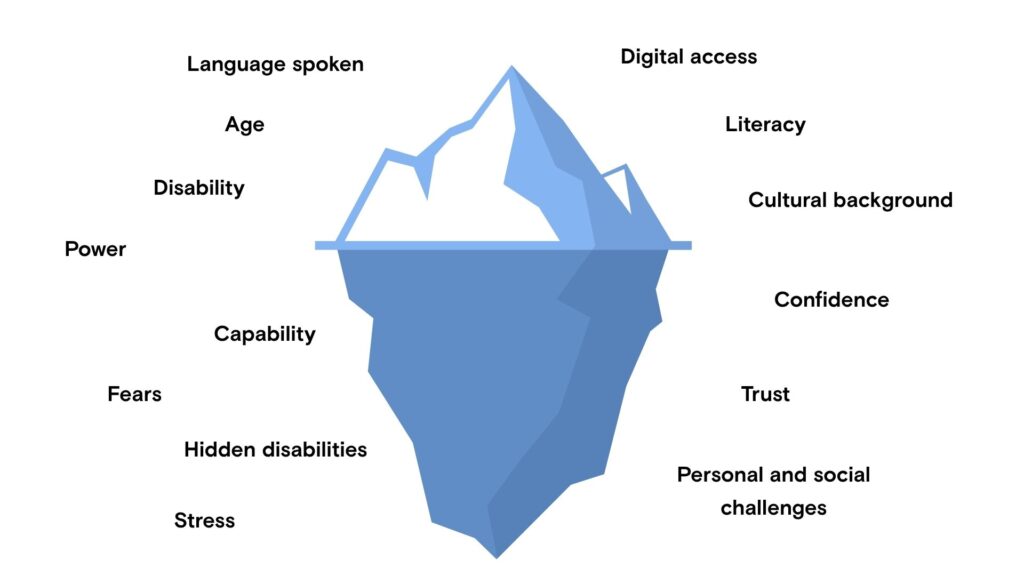
Know your audience below the waterline
Some things about your audience are easy to find out. Things like their age, language spoken, disability status, cultural background, literacy level, digital access. These sit above the waterline.
But there’s far more below it. Hidden disabilities, personal and social challenges, levels of trust and confidence, capability, and critically, stress and fear.
Trauma directly impairs comprehension. When someone is anxious or overwhelmed, their ability to process information drops sharply.
For health and aged care organisations and not-for-profits working with vulnerable communities, this matters enormously. A communication that works for someone in a calm, informed state may completely fail someone who is scared, grieving, or in crisis.
The three most common mistakes
1. Background first, not last
Most documents lead with context. They explain the history, the policy rationale, the organisational structure, before getting to the actual point. This mirrors the way essays are written and the way we naturally speak. But for readers who aren’t already invested, it means the main message is buried. Put the most important information first. If readers want context, they’ll keep reading.
2. Jargon and technical language
Sector-specific language is so embedded that writers often stop noticing it. “Industrial action” instead of “strikes”. “Residential waste collection” instead of “household bins”. “Utilise” instead of “use”. Each one adds cognitive load. When your audience isn’t a subject matter expert, jargon creates distance and confusion.
3. Walls of text
A long, unbroken block of text forces the reader to do the work of finding the message. With the volume of content people encounter daily, most won’t bother. This applies to websites, social media captions, reports, forms, and anything else going to a public audience.
Four principles you can use today
These techniques come directly from the ISO plain language standard. Each one can be applied to the next thing you write.
1. Use everyday words
Swap formal or technical terms for the words people actually use. The goal is to reduce the reading level without reducing the meaning.
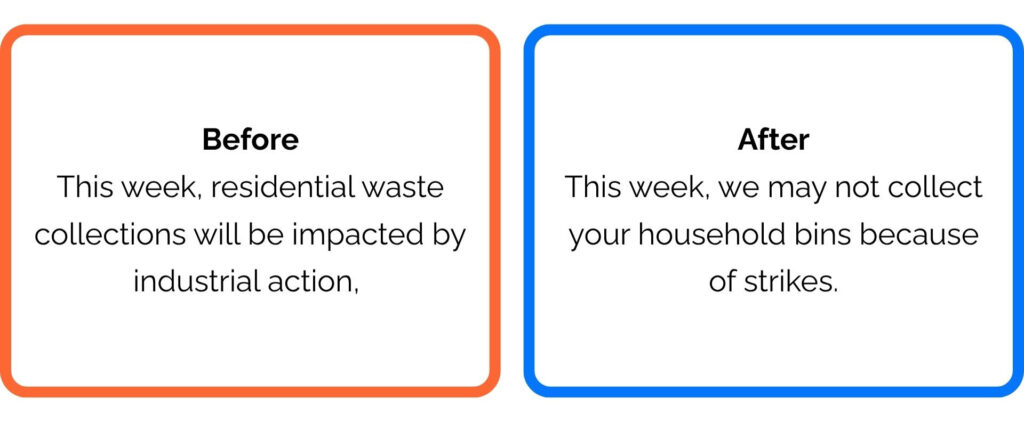
The “before” example above sits at a grade 13 reading level (university). The plain language version sits at grade 7. Same information, dramatically different accessibility.
You can test your own writing for free using Hemingway App or the readability checker built into Microsoft Word.
This principle matters even more when the stakes are high. Punchy’s NSW Cancer Council animation demonstrates it clearly. Rather than introducing “biopsy” as a standalone term, the script leads with plain language first: “Sometimes the doctor may also take a small piece of tissue. This is called a biopsy.” The technical word is used, but only after the reader already understands what it means.
2. Write in the active voice
Passive voice constructs a sentence around the object first, then the action, then who did it. Active voice leads with the subject.
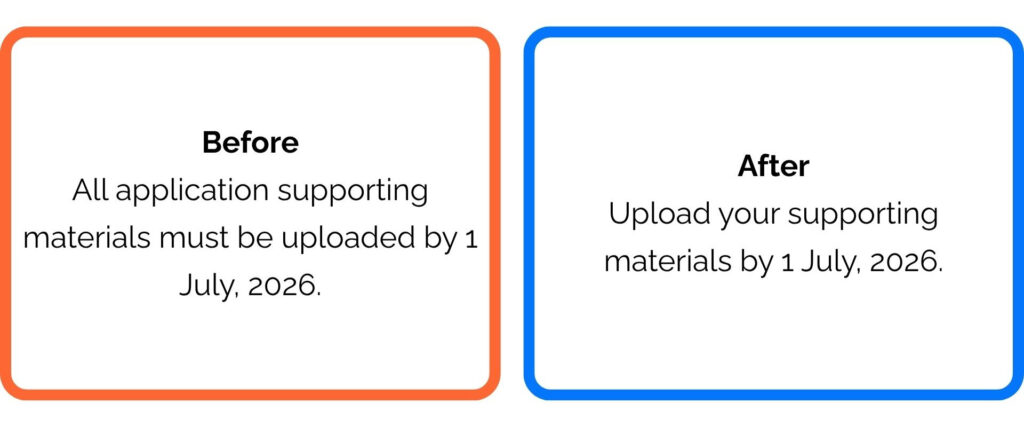
Passive constructions are common in government and corporate writing because they feel formal and authoritative. But they also create distance and increase cognitive load. Active voice helps readers see themselves in the instruction, and as a bonus, it almost always makes the sentence shorter too.
Punchy’s animation for Settlement Services International is a useful illustration.
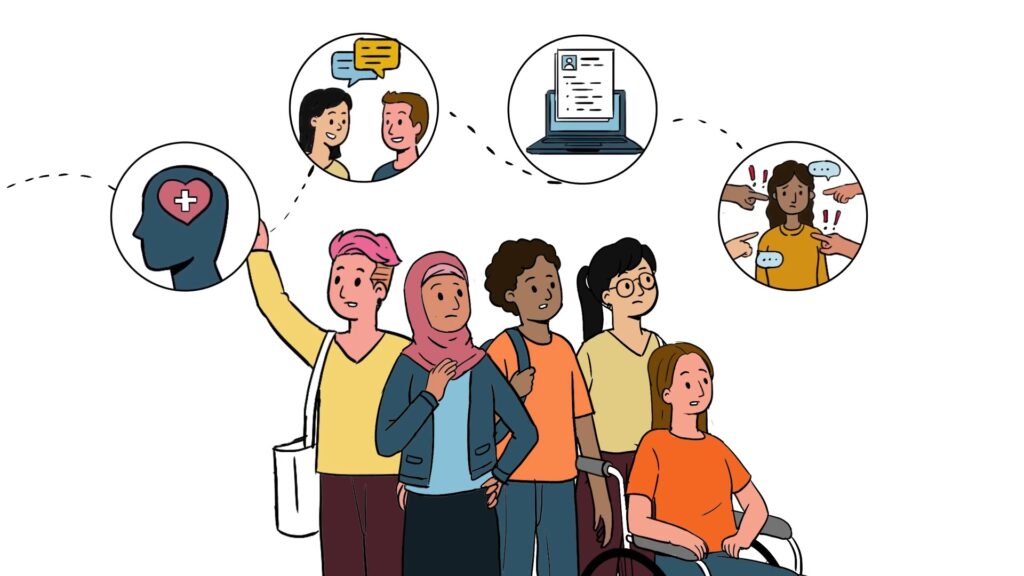
Every line speaks directly to the viewer: “You have a right to speak up, be heard, and not be afraid of unfair treatment. Talk to your provider to find a solution.” No passive constructions, no institutional distance. The viewer is addressed as a person with agency, not as a recipient of a process.
3. Write shorter sentences
Research from the American Press Institute found that at an average sentence length of eight words or fewer, readers understood 100% of the content. At 14 words, that dropped to 90%. At 43 words, it fell below 10%.
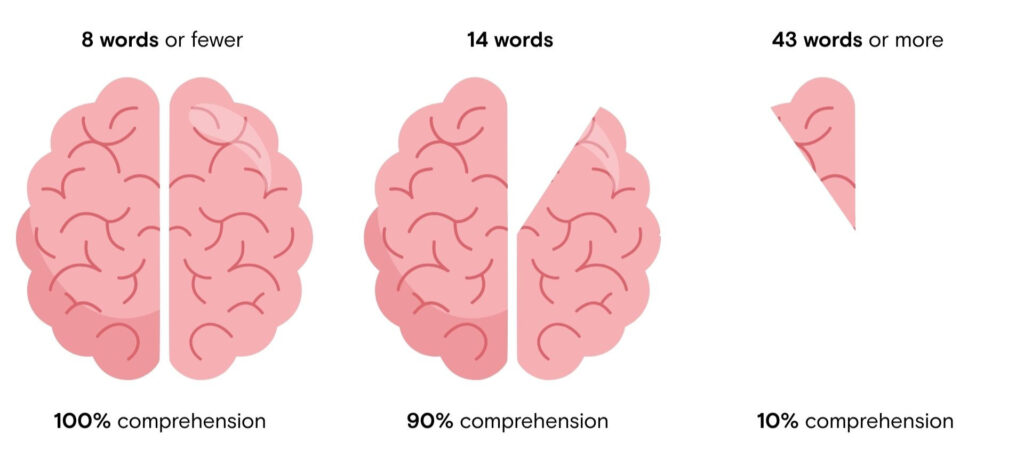
Practical ways to apply this:
- One idea per sentence
- Aim for 15 to 25 words
- If a sentence contains “and”, “but”, or “as well as”, it can often be split in two
- Remove filler words and repetition
4. Get your structure and format right
This is about making your content scannable. Most readers won’t read every word. They skim to find what’s relevant to them, then read more closely if it is.
Practical techniques:
- Use headings that describe the content specifically, not vaguely. “Service update” tells readers nothing. “Your bins may not be collected this week” tells them exactly what they need to know.
- Put the most important information first, not last
- Use dot points for lists, steps, and options
- Build in white space between sections
The same principle applies when the source material is a large document.
Punchy’s animation for City of Whittlesea turned a 40-page piece of local legislation into a two-minute video. The content didn’t change. The structure did. By identifying the key information residents actually needed and presenting it in a clear, logical sequence, the result was something people could follow and act on.
For local councils, state government agencies, and health organisations, reworking high-traffic pages and documents using these techniques can have a significant impact.
The wider picture
Australia hasn’t yet legislated plain language. The US did so in 2010, New Zealand in 2022. Victoria launched an accessible communications policy in August 2024 that includes plain language as a requirement, which is a positive step forward.
Legislative change tends to follow cultural change. As more communicators push for clearer standards, and as audiences begin to expect them, the case for formalising those standards becomes harder to ignore.
For organisations working across government, education, and not-for-profit sectors, it’s worth reviewing the essential information you currently produce and asking whether it would pass the plain language test. The changes are often simpler than they look, and the community impact can be huge.
If you want to talk through how video can help you translate complex information for a wider audience, get in touch with the Punchy team.