Video production in Australia typically costs between $4,950 and $7,450 per shoot day for a professionally produced corporate video, with most single-location projects landing somewhere in that range depending on a handful of key variables. If your project spans multiple locations, requires specialist crew, or involves professional on-screen talent, expect the budget to increase accordingly.
This post walks through what those variables are and what realistic price ranges look like across different video types.
Why video production costs vary so much
If you have ever received two quotes for what felt like the same project and found them thousands of dollars apart, you are not imagining it. Production involves a lot of moving parts, and the cost of each one compounds. Understanding what actually drives price is the fastest way to scope your project honestly and build a budget that holds.
Video length and shoot days
This is the single biggest lever on cost. A half-day shoot (four hours) covering one or two interview setups with b-roll is a very different scope to a full day across multiple locations with multiple talent. Most straightforward corporate interviews or testimonial videos can be captured in a half-day. Brand and culture videos that need a range of settings, faces, and footage types typically require a full day or more.
Finished video length also affects post-production time. A tightly edited two-minute piece is generally faster to cut than a three-minute video with a more complex narrative arc, though this depends on the edit approach and how much raw footage is involved.
Crew size and equipment requirements
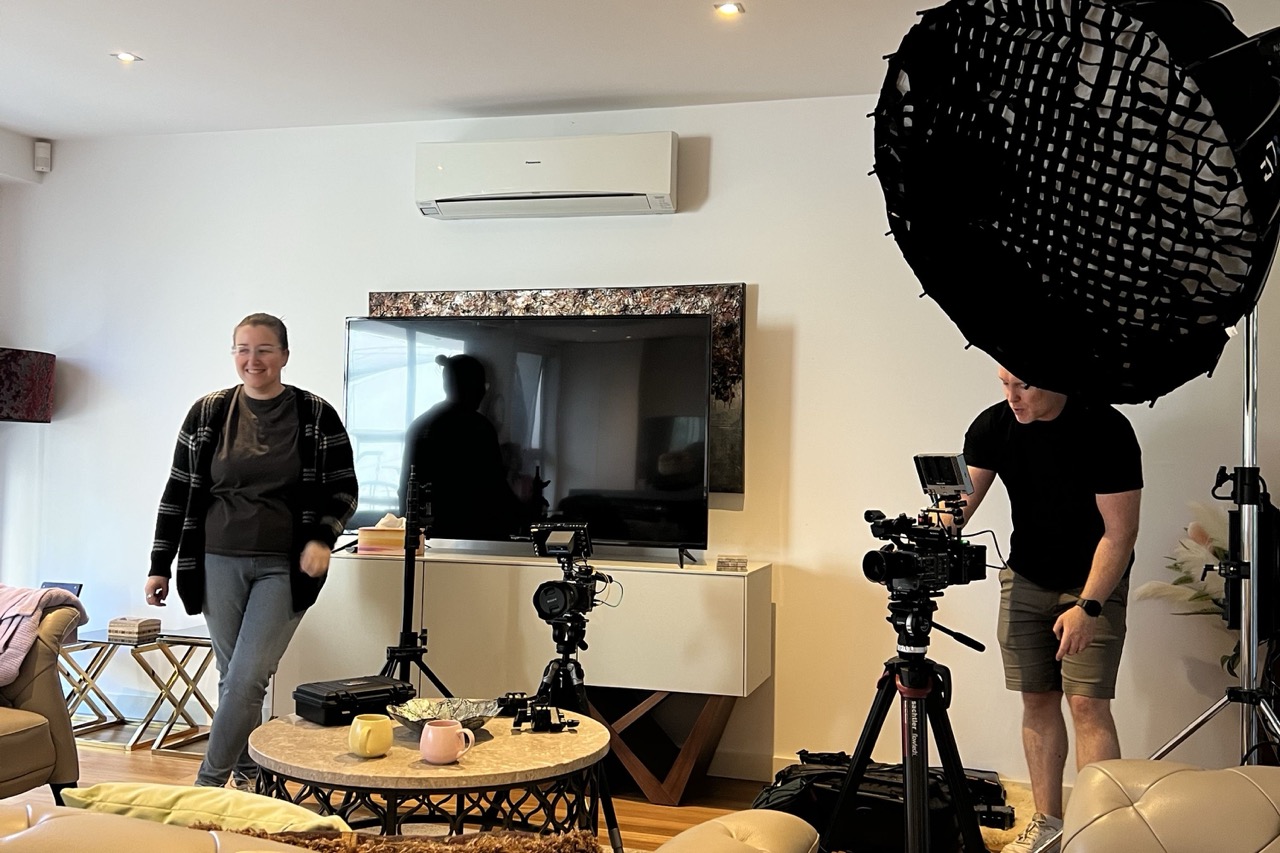
A standard live action production package typically includes a dedicated cinematographer and producer. Depending on the project, you may need additional crew: a second camera operator for event-style coverage, a lighting technician for controlled studio environments, or a drone operator for aerial footage.
Drone footage adds roughly $2,000 for a half day or $3,250 for a full day per operator. Additional filming crew at the same rates apply when extending a shoot beyond the original scope.
These add-ons are worth knowing about upfront because they are often the items that appear midway through a project and push costs beyond the initial estimate.
Location: on-site vs studio and interstate shoots
Shooting at your own premises is usually the most cost-efficient option, as long as the space is suitable. Controlled lighting, quiet audio conditions, and enough room to set up equipment all matter. When the location is not ideal, a hired studio or alternative venue adds location fees to the budget.
Interstate projects add travel costs for the crew. A Sydney-based organisation commissioning a shoot in Perth will need to factor in flights, accommodation, and travel time. For organisations with multi-city footprints, it is worth discussing whether footage from different locations can be captured efficiently in one trip, rather than scheduling separate shoots.
Talent: staff-led vs professional and voiceover
Staff-led videos, where your own team members speak to camera, are a common and effective format for organisations in government, health, and the not-for-profit sector. They carry authenticity that professional talent cannot replicate, and they do not attract casting and talent fees.
When professional on-screen talent is required, casting and talent buyout fees apply. These vary depending on usage rights, the profile of the talent, and how broadly the video will be distributed. Professional voiceover recording is available as an add-on, priced at $200 per finished minute.
Post-production: editing, colour grading, music, captions
Post-production is where raw footage becomes a finished video, and it is easy to underestimate the work involved. A professional edit includes colour correction, text graphics, and royalty-free background music as standard. More complex edits involving motion graphics, animation overlays, or multi-camera sequences take longer and cost more.
If you need animation elements added to footage to illustrate a process or add visual explanation, that is quoted separately. Typical packages should include a complimentary cut-down of the main video, which is useful for social media distribution.
Captions and accessibility versions can be added on request. Audio descriptions, for audiences who need a verbal description of on-screen action, are quoted separately based on video length.
Revision rounds and turnaround time
One of the factors that often catches organisations off-guard is revision rounds. Multiple rounds of feedback, particularly when they involve significant structural changes to the edit, can add up quickly if they fall outside what is included in the original agreement.
Look for suppliers who include unlimited revisions as part of their package, rather than capping rounds at two or three. This matters especially in government and health contexts, where approvals may involve multiple stakeholders and content may need to be revisited as policies evolve.
Express turnaround is available on request, subject to availability, and is priced separately. Standard production timelines vary depending on project complexity and current scheduling.
Rough price ranges by video type in Australia
The following ranges are indicative. Final costs depend on scope, locations, talent, and post-production requirements. All prices exclude GST.
- Single-location corporate interview or talking head: typically from $4,950 for a half-day shoot with a single cinematographer, edit up to two minutes, and one cut-down included.
- Multi-location brand or culture video: typically from $7,450 for a full-day shoot, edit up to three minutes, and one cut-down. Add-ons for additional crew, drone, or extended filming increase this further.
- Case study or client testimonial video: typically from $4,950 to $7,450 depending on the number of interview subjects and locations. Case study videos often involve one or more subjects with supporting b-roll, capturable in a half or full day.
- Training or workplace safety video: varies significantly based on script complexity, the number of scenarios to film, and whether the finished video requires accessibility features such as audio descriptions or Auslan interpretation. Organisations planning a series can reduce per-unit cost through package pricing.
- Product or service demonstration video: depends on the number of products or use cases being filmed, location requirements, and whether professional talent is needed on screen.
For organisations commissioning multiple videos across a financial year, volume pricing can significantly reduce per-video cost. A $15,000 upfront commitment, for example, can unlock 10% additional production value across projects delivered within 12 months.
What is often not included in a quote
A few items consistently catch buyers off-guard when they appear in a final invoice but were not clearly scoped at the outset.
- Location permits: filming in public spaces, government buildings, or venues with controlled access often requires permits. Processing times and fees vary by state and location.
- Talent buyouts: if professional on-screen talent is used, usage rights need to be negotiated. Broader distribution rights cost more than a one-time internal use.
- Music licensing: royalty-free music is included in standard packages, but if your brief requires a specific track or style, licensing fees apply separately.
- Props and location hire: any specific set dressing, props, or venue hire required for the shoot are typically quoted as line items.
- Rush fees: express turnaround is available but priced separately and subject to availability. Building adequate lead time into your project timeline avoids this cost entirely.
- Additional revision rounds: if your supplier caps revision rounds, additional rounds are charged at hourly rates. At $150 per hour for editing, this can accumulate quickly on complex projects with multiple approvers.
How to get an accurate quote
The more specific your brief, the more accurate your quote. Suppliers cannot give you a reliable number without knowing the following:
- Objective: what do you want this video to do, and for which audience?
- Finished length: an approximate target, even if it changes later.
- Locations: how many, where, and whether access is straightforward.
- Talent: will you be using your own staff, or do you need talent sourced?
- Timeline: your preferred delivery date and any hard deadlines.
- Distribution: where the video will be used, including any accessibility or format requirements.
Even a rough brief gives a good supplier enough to ballpark the cost and flag anything that could push the budget. The conversation is low-stakes at this stage; a quote is not a commitment.
If you work in government, health, or the not-for-profit sector, also consider whether your supplier has relevant sector experience. Brand video production for a public health campaign looks very different to a commercial brand campaign, and suppliers with that context will scope it more accurately and efficiently.

Ready to get a clearer picture of your project cost?
The ranges above give you a working ballpark, but your project has its own specific requirements. The most accurate way to understand what your video will cost is to talk through your brief directly.
Take a look at our live action portfolio to see the kind of work we produce across government, health, and not-for-profit sectors.
When you are ready to explore options for your own project, get in touch with our team and we will walk you through what a realistic scope and budget looks like for your brief.